
Putin's War Against Comedy
Russia Just Deported Its Jimmy Kimmel

Banned for Half a Century
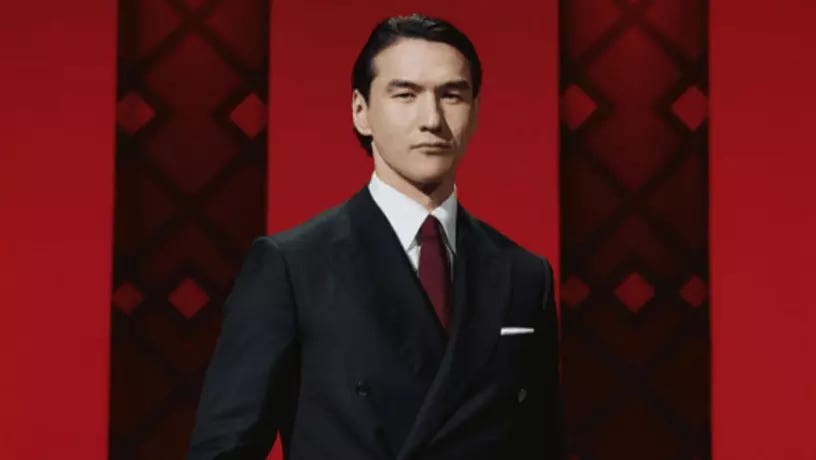
The most talked-about person in Russia this past week has not been a general, an oligarch, or an opposition politician. It has been Nurlan Saburov — arguably the most famous Russian-language stand-up comedian alive today.
For years, Saburov lived in Russia and hosted the country’s most popular comedy show. His face was everywhere; his audience massive. Yet he is not a Russian citizen. He holds a Kazakh passport.
On February 6, Saburov landed at Moscow’s Vnukovo Airport. Instead of heading into the city, he was met by officers from the FSB, Russia’s security service. They informed him that he would not be allowed to enter the country. More than that, he was banned from returning for the next fifty years.
Nurlan Saburov
In the United States, deportations have become a grimly familiar routine over the past year — a visible marker of a new political reality. In Russia, however, such measures remain far less common, especially when applied to public figures of Saburov’s stature. The Kremlin more often relies on criminal cases, “extremism” charges, administrative arrests, or prison sentences. Given the serious prosecutions and real jail terms imposed on some Russian comedians in recent years, one might say Saburov got off relatively lightly.
Yet the expulsion of the country’s most commercially successful stand-up comic signals something important. Comedy matters in Russia, just as it does in America. Even when it avoids direct political satire, it creates space for irony, distance, and doubt. That alone can make authorities uneasy.
“Butts Are Clenched a Little Tighter”
Nurlan Saburov was born in Stepnogorsk, Kazakhstan — a city about 200 kilometers from Astana, the country’s capital. After finishing school, he moved to Russia and began performing stand-up. In 2014, he relocated to Moscow.
He soon became a host on a television talk show while building a large following on YouTube. It was online that he became a superstar.
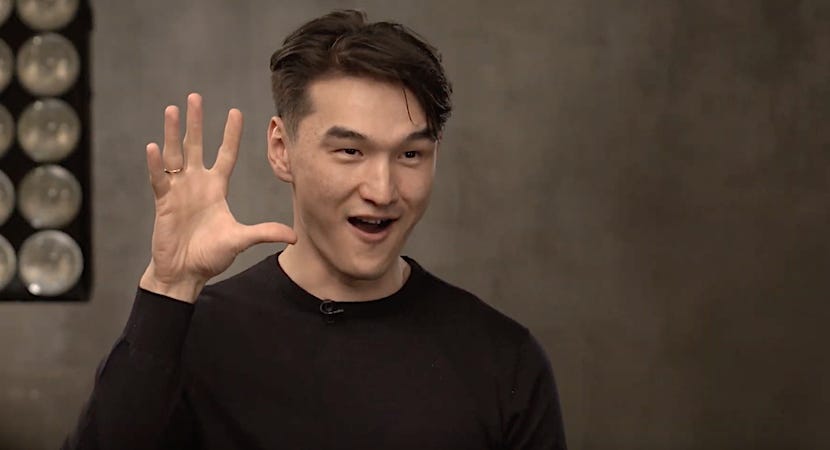
In 2019, Saburov became one of the hosts of the show What Happened Next?, which went on to become the most popular and highest-grossing show in the Russian-language segment of YouTube. By then, Saburov had become one of the most recognizable online personalities in Russia.
That same year, at the height of his popularity, he gave an interview to Russia’s best-known YouTube journalist, Yuri Dud. In that conversation, Saburov openly admitted that he was afraid to joke about politics. At the same time, he argued that the atmosphere in Kazakhstan — and even in Belarus — felt more constrained than in Russia. In Kazakhstan, he said, “people’s butts are clenched a little tighter.”
Everything changed in 2022, when Russia launched its full-scale invasion of Ukraine.
Laughter and the War
Comedians responded to Russia’s invasion of Ukraine in different ways. What was striking, however, was that many of Russia prominent stand-up performers publicly opposed the war. In that sense, protest became less an exception than a norm within large parts of the Russian comedy scene.
The case of Ivan Urgant, the most popular television host and comedian in Russia, is especially telling. Urgant hosted a nightly show on the state-owned Channel One — roughly comparable to The Daily Show in format and influence.
In the first days of the war, Urgant, like many of his colleagues, posted an anti-war message on social media. Shortly afterward, he left Russia for Israel. His program was immediately taken off the air, and several prominent propagandists publicly labeled him a traitor.
Later, however, Urgant reconsidered his departure and attempted to have his show reinstated on Russian television. These efforts failed. Today he occupies an ambiguous position. On the one hand, he remains effectively banned from federal television. On the other, he continues to live in Russia and refrains from openly criticizing the war. At the same time, he tours successfully across Europe and Asia with live performances.
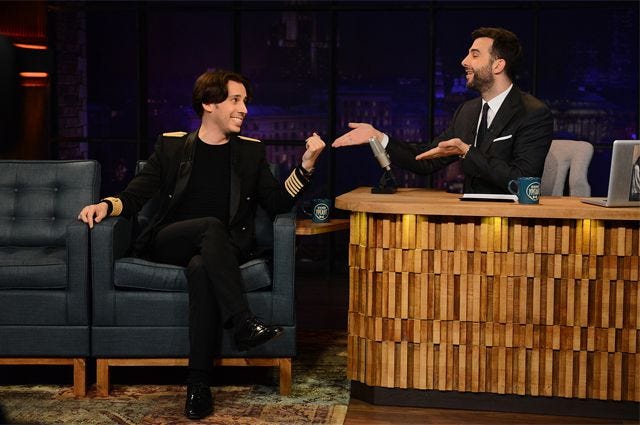
Ivan Urgant (right) and Maxim Galkin (left)
A very different path was taken by another well-known television host and comedian, Maxim Galkin — the husband of Alla Pugacheva, the most iconic Russian singer of the past half-century.
From the very beginning of the war, Galkin spoke out against it and never retreated from that position. In the summer of 2022, he was designated a “foreign agent,” after which he and his family moved first to Israel and later to Cyprus. Over the past several years, he has consistently criticized the Russian authorities and openly supported Ukraine.
At the same time, he has become one of the most in-demand Russian-language performers worldwide, maintaining an almost continuous touring schedule across Europe, Asia, Australia, and North America.
In this sense, Galkin is a remarkable figure. For many years he had not been associated with politics at all; on the contrary, he was effectively the face of light, mainstream entertainment on pro-Kremlin television. Today he is both a principled critic of the regime and a highly successful stand-up performer filling large venues around the world.
One of the most striking features of the post-2022 period has been the mass departure of Russian stand-up comedians. They left in large numbers. Major figures such as Semyon Slepakov, Danila Poperechny, Ruslan Bely, and Alexander Nezlobin all chose exile. Some now live in Los Angeles, others in Europe or Israel, but all tour extensively worldwide, consistently filling large halls.
Their humor is overtly political — explicitly anti-war and anti-Putin. They do not pretend that nothing is happening, nor do they attempt to avoid reacting to the war. On the contrary, many speak with a sharpness and moral clarity comparable to that of independent investigative journalists. In that sense, the active role played by comedians has shaped the broader cultural landscape.
Saburov’s Choice
Saburov made a different choice. Despite not holding a Russian passport — or even a residence permit — he decided to remain in Russia, even though in the spring of 2022 — during the first months of the war — he had a major U.S. tour scheduled, performing for Russian-speaking audiences.
On April 9, Saburov appeared on stage in Los Angeles. During the show, someone in the audience shouted: “Children are dying in Ukraine. Why are you silent?” Saburov replied that he “sincerely sympathized.” “Yes, I’m a jerk. I have plenty of flaws. But I’m not an idiot. When I see those images, I don’t think it’s right. What are you trying to make me into?”
At the same concert, another voice from the audience yelled: “Why have you swallowed your tongue?” Saburov responded: “Brother, I have a family. You have to understand that I have my own fears. What are you trying to make me into? Guys, if you really think I support this, then you’re idiots.”
A few days later, at his concert in San Francisco, a Ukrainian artist and activist, Yulia Kosivchuk, ran onto the stage. She was wearing a white dress stained with red paint meant to symbolize the blood of Ukrainians. Kosivchuk demanded that Saburov publicly state his position on Russia’s invasion.
Saburov did not respond to her demand. As security escorted her out of the venue, he commented on her dress: “What is that, your period?”
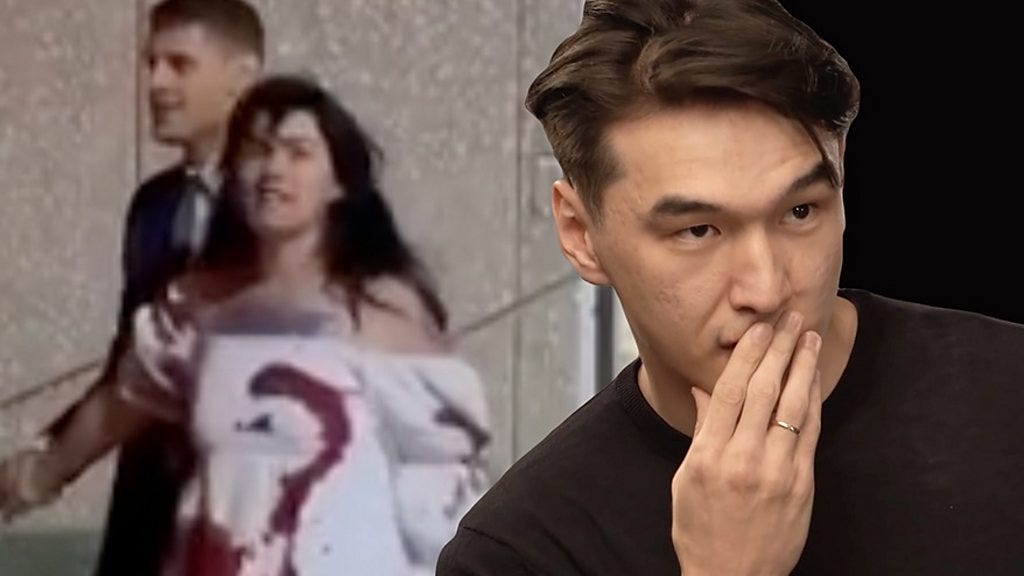
Kosivchuk and Saburov
The remark triggered intense backlash on social media. Soon after, his concert in Chicago was canceled. Performances were later canceled in Israel and even in his native Kazakhstan.
After the controversy in the United States, Saburov returned to Russia and tried to continue working and touring there.
What followed became part of a much larger political shift.
Before the war, YouTube had been the primary — and in many ways the only — major video platform in Russia where high-quality Russian-language content, both journalistic and entertainment, was widely available. It was the central hub for independent media, long-form interviews, and large-scale comedy projects, including Saburov’s What Happened Next?.
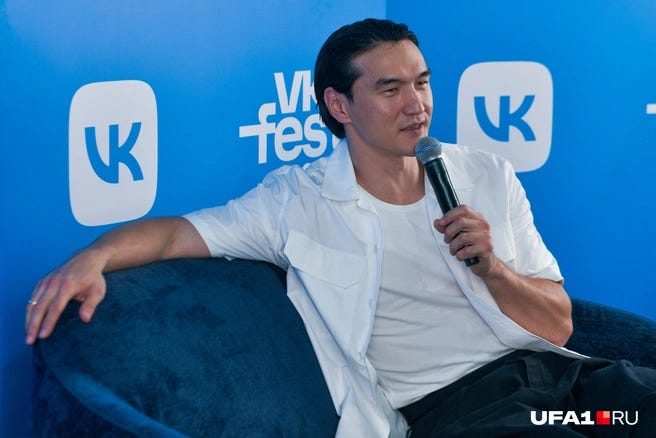
In 2023, Russian authorities began preparing for the gradual restriction and eventual blocking of YouTube. As part of that effort, an alternative video service was built on the basis of the Russian social network VK.com. Popular non-political bloggers were encouraged (or forced) to move their shows and audiences to this platform.
Saburov did not refuse.
His show migrated to VK’s streaming service, and previous episodes were removed from YouTube. As YouTube later became increasingly restricted in Russia — accessible only through VPN — the move effectively placed his content within the state-controlled digital ecosystem.
The Italian Strike
Yet Saburov’s loyalty did not fully protect him.
According to my sources in Moscow, he was repeatedly summoned to the FSB — specifically to the Directorate for the Protection of the Constitutional Order and the Fight Against Extremism — and persistently pressured to cooperate.
Since the start of the war, Russian authorities have actively sought to recruit public figures as visible supporters of the invasion. Many celebrities — especially artists and musicians with large audiences — have tried to avoid doing so. Performers who remain in Russia often describe their strategy privately as an “Italian strike.” Open protest is impossible. The only viable option is quiet avoidance: decline invitations to propaganda events, refuse trips to occupied territories, and steer clear of concerts, films, or performances that glorify the war.
For many Russian stars, this strategy has worked.
At the same time, the presidential administration and the FSB continue to apply psychological pressure to high-profile figures. Saburov, as one of the country’s most popular entertainers, inevitably drew attention.
He did not publicly endorse the war. He did not travel to occupied territories. He also occasionally joked about xenophobia and racism toward Asians in Russia, including Kazakhs. In the context of increasingly tense relations between Russia and Kazakhstan, such jokes did not go unnoticed.
According to my sources, Saburov was summoned several times for “conversations” and encouraged to cooperate, but he consistently refused.
