
Russia’s Empty Tank
For the first time, millions of Russians are feeling the war in their everyday lives

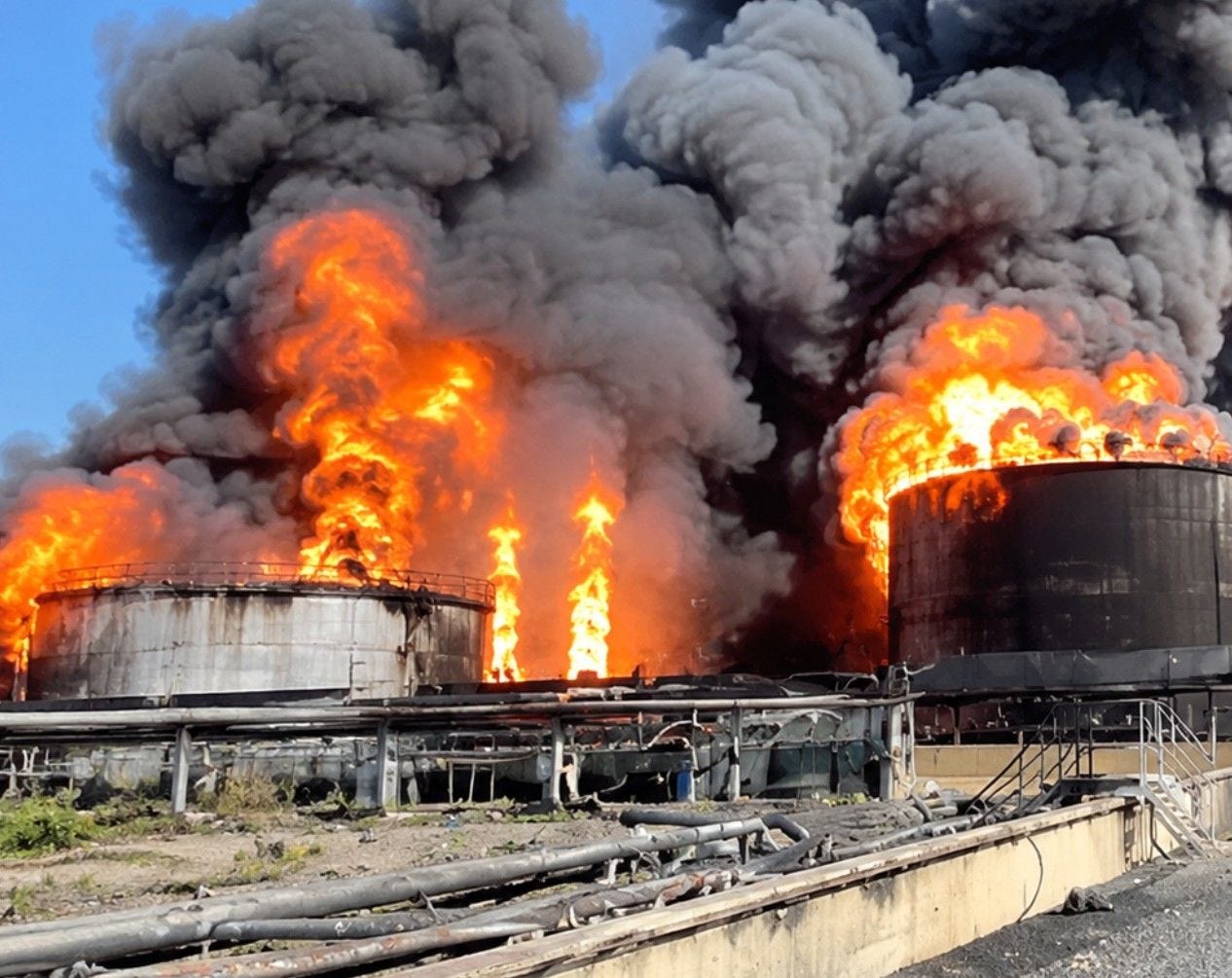
Russia is experiencing its worst fuel crisis in more than two decades. As Ukrainian drone strikes cripple oil refineries across the country, gasoline shortages have spread to dozens of regions, exposing how the war is beginning to disrupt the everyday lives of ordinary Russians. In Moscow, some drivers are getting up as early as 3 a.m. to queue at gas stations in the hope of filling their tanks.
Europe Without Gas
Two years ago, Russian state propaganda channels gleefully reported on what they claimed was happening across Europe. According to their coverage, gas stations were running out of fuel, enormous lines had formed, drivers were limited to just 20 liters per vehicle, and some cars could not refuel at all. This was presented as proof of the catastrophic energy crisis that had supposedly engulfed Europe after sanctions were imposed on Russian energy exports. Russian state media insisted that, without trade with Russia, European countries were incapable of supplying themselves with fuel and that Europe’s energy system was on the verge of collapse.
Ironically, this is precisely the scenario now unfolding in Russia itself. At least two-thirds of the country’s regions have either introduced fuel rationing or are experiencing supply disruptions as a result of the relentless Ukrainian drone attacks on oil refineries.
Gasoline shortages have become part of everyday life—including in Russia’s own oil-producing regions. Depending on the estimate, between 20 and 60 regions are now experiencing fuel shortages.
Russia is clearly facing its worst fuel crisis in more than two decades. Following a series of Ukrainian strikes on oil refineries—16 facilities were attacked in May and another eight in June—gasoline production has fallen by roughly a quarter and now trails domestic demand by about 20 percent.
Russia halted exports of most gasoline back in April, although its exports had never been particularly large to begin with. Rising fuel prices are especially alarming for the authorities because they have triggered social unrest in the past. The issue has become even more politically sensitive as the Kremlin prepares for parliamentary elections in September.
War came home
Over the past week, the fuel crisis has become one of the country’s main topics of public discussion, effectively eclipsing even the widespread debate over internet shutdowns. At the same time, it has emerged as perhaps the clearest symbol of the dead end into which Russia has driven itself as a result of the current war. Yet the word “war” itself remains taboo, forcing people to discuss what is happening only through hints and euphemisms. The fuel crisis has become one of those subjects that makes it increasingly difficult to avoid acknowledging the real causes of what is happening.
Fuel shortages first began to appear about two weeks ago, when Ukrainian drone attacks on Russian oil refineries became so systematic that they started to affect everyday life across the country.
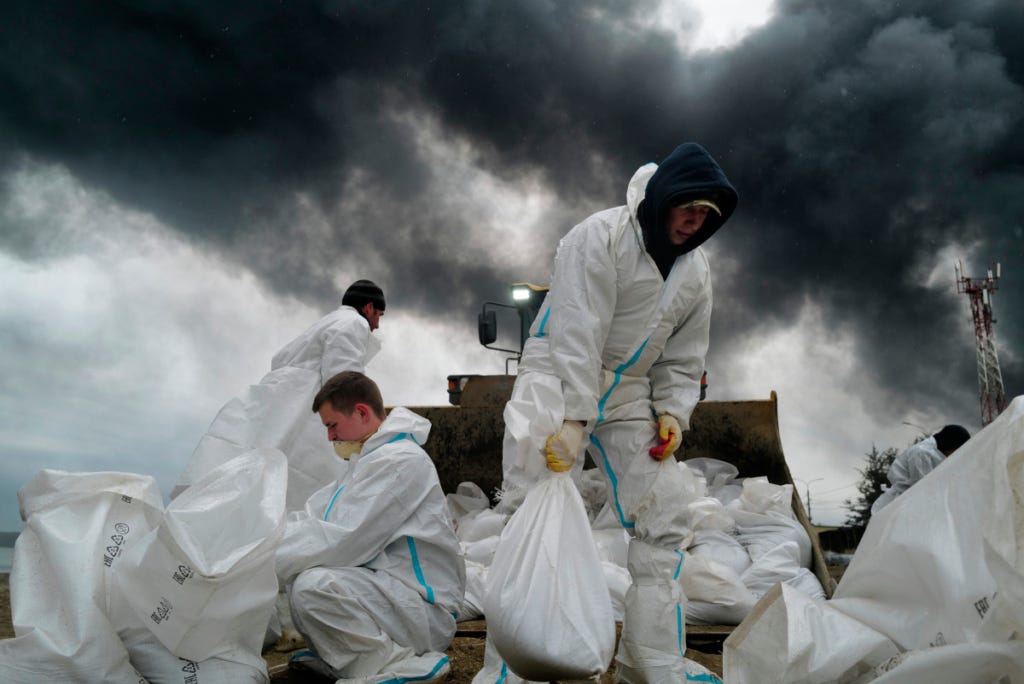
Volunteers in Tuapse are trying to clean oil residue from the coastline
The first serious consequences became apparent as early as the spring. In March, a major strike hit the oil refinery in Tuapse. According to industry sources, the facility handled roughly 15 percent of Rosneft’s oil exports. A series of subsequent attacks effectively put the refinery out of operation. They also triggered a large-scale oil spill that polluted Russia’s Black Sea coastline.
Tuapse is located just a short distance from Sochi, Russia’s most popular Black Sea resort. Yet the spill was met with remarkable indifference from the Russian authorities. For months, local volunteers have been trying to clean the coastline and rescue wildlife affected by the contamination, while officials have continued to pretend that nothing out of the ordinary has happened. The governor of the Krasnodar region, Veniamin Kondratyev, publicly insisted that there was nothing alarming about the incident. He remarked that he himself had swum in oil-contaminated seawater as a child and claimed that such conditions had always been perfectly normal. In reality, however, the pollution of the Black Sea turned out to be only the beginning of the story.
During the opening days of the St. Petersburg International Economic Forum, Ukrainian drones struck an oil refinery in the Leningrad region. Shortly afterward, local gas stations introduced restrictions on gasoline sales. Nevertheless, in his keynote speech at the forum, Vladimir Putin did not mention the emerging fuel shortages even once. On the contrary, he projected complete confidence in Russia’s success and spoke exclusively about the country’s achievements in the war.
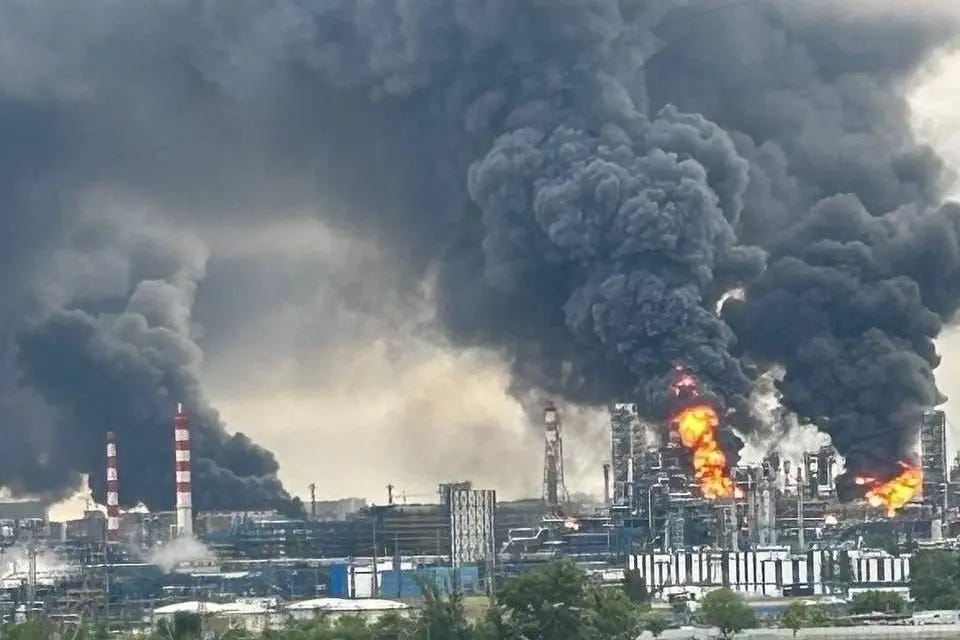
Explosion at Moscow “Kapotnya“ oil refinery
Perhaps the most symbolic attack on Russia’s oil infrastructure came on June 18, when Ukrainian drones targeted Moscow itself. One of the targets was the Kapotnya oil refinery. Footage of the massive explosion at the facility became one of the most widely shared videos on the Russian internet in recent weeks.
Empty Pumps, Silent Television
What happened next was equally striking. State media outlets were instructed to ignore the attack as much as possible. The largest drone strike on Moscow to date received only a brief mention in the morning news broadcasts. By the afternoon—and especially by the evening—the incident had disappeared entirely from state television coverage.
Only several days later did Vladimir Putin indirectly address the Ukrainian attacks on Russia’s energy infrastructure for the first time. Speaking at a meeting with veterans of the so-called “special military operation,” he argued that the Russian army was advancing so successfully and capturing new settlements every day that the Ukrainian drone strikes were merely an attempt to distract the Russian public, sow anxiety, and undermine confidence. According to Putin, victory is already within reach, and all the objectives assigned to participants in the “special military operation” will soon be achieved.
In his latest interview with state television this past Sunday, Putin repeated the same talking points, insisting that the damage to Russia’s energy infrastructure was insignificant and that all the refineries would soon be repaired. At the same time, he spoke of nonexistent successes on the front and promised that Russia would achieve military victory in the near future.
State media have said very little about the scale of the fuel crisis now unfolding across Russia. According to Forbes Russia, gasoline sales have been restricted in nearly 60 regions. Other Russian outlets offer more conservative estimates, putting the number at around 30. Even the lower estimate, however, makes it clear that this is no longer a localized disruption but a nationwide crisis.
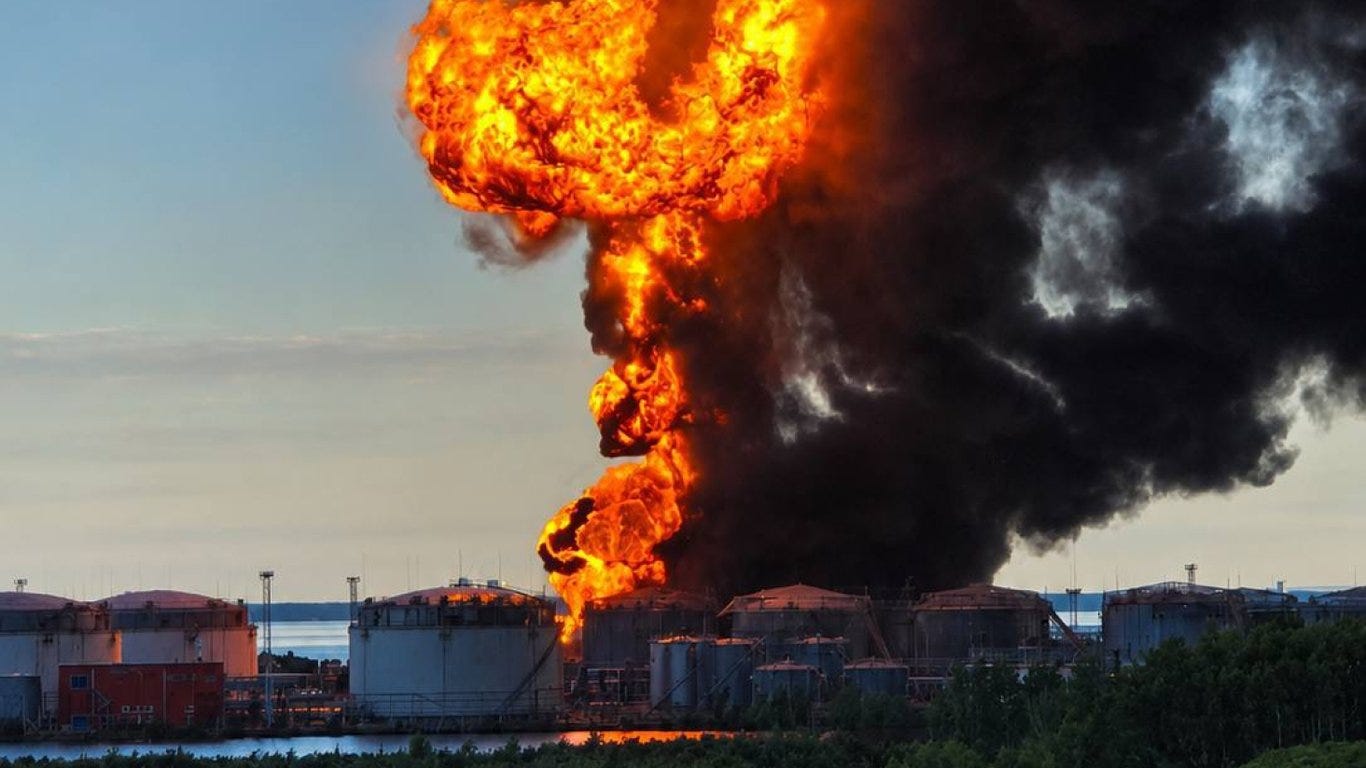
Explosion at Saint Petersburg oil refinery
Remarkably, fuel restrictions have also been introduced in regions that have never been targeted by Ukrainian drone strikes. In the Novosibirsk region, for example, gasoline sales were limited purely as a precaution. Similar measures have been adopted in the Khanty-Mansi Autonomous Okrug, Russia’s largest oil-producing region. Meanwhile, pro-war Z-channels have reacted with undisguised schadenfreude, writing that residents of Russia’s remote regions are finally experiencing what life has long been like in Crimea, where fuel shortages have persisted for months.
Russia has already begun importing gasoline from Belarus. Those deliveries, however, are clearly insufficient. As a result, the Russian government is simultaneously discussing gasoline imports from India, negotiating with Kazakhstan for the urgent purchase of another 50,000 tons, and has even authorized refineries to produce lower-quality fuel. A country that remains one of the world’s largest exporters of oil and natural gas has suddenly found itself unable to supply its own population with gasoline.
No More "Not Our War"
That is perhaps why the current crisis has had such a powerful psychological impact on ordinary Russians. For the past four years, many had tried to convince themselves that the war had nothing to do with them, repeating the familiar refrain: “We’re not interested in politics.” It is becoming much harder to pretend that what is happening is taking place somewhere far away.
The consequences are already being felt across a wide range of industries. Companies that rent boats and jet skis to tourists, for example, have all but ceased operating. They used to buy gasoline in jerry cans, but under the new restrictions gas stations are allowed to pump fuel only directly into vehicle tanks. Filling portable fuel containers has now been prohibited.
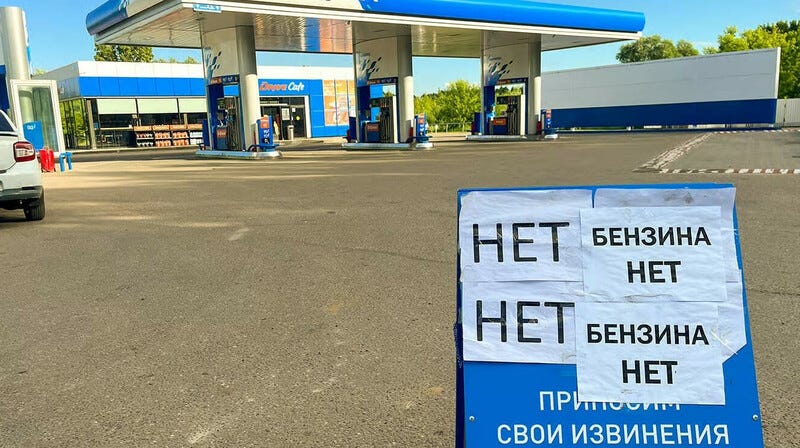
“No petrol, our apologies”
In St. Petersburg, popular local news outlets are warning that taxis may soon become a luxury for ordinary Russians. “Passengers should prepare for a sharp rise in fares because of fuel shortages,” one outlet wrote. “As gasoline becomes harder to obtain, fewer drivers will remain on the road, driving up both demand and prices.”
There are other, more mundane signs of the crisis. Russian search engines have recorded a sharp increase in searches for “how to siphon gasoline from a fuel tank.” It is a skill that many Russians associated with the hardships of the 1990s and assumed had long since become obsolete. Now, many are once again finding themselves forced to remember such methods of obtaining fuel.
At the same time, gasoline theft from parked cars has become increasingly common. Car owners can no longer be certain that, after filling up, their tanks will still be full by the time they next need to drive.
Perhaps the most telling aspect of the crisis is that all of this is unfolding in near-total silence from the state media. The fuel shortages began at the start of summer, precisely when millions of Russians traditionally set off on vacation in their own cars. For many of them, those plans have already been derailed.