
When the Internet Disappears
Shutdowns, rumors, elite anxiety, and the return of political fear

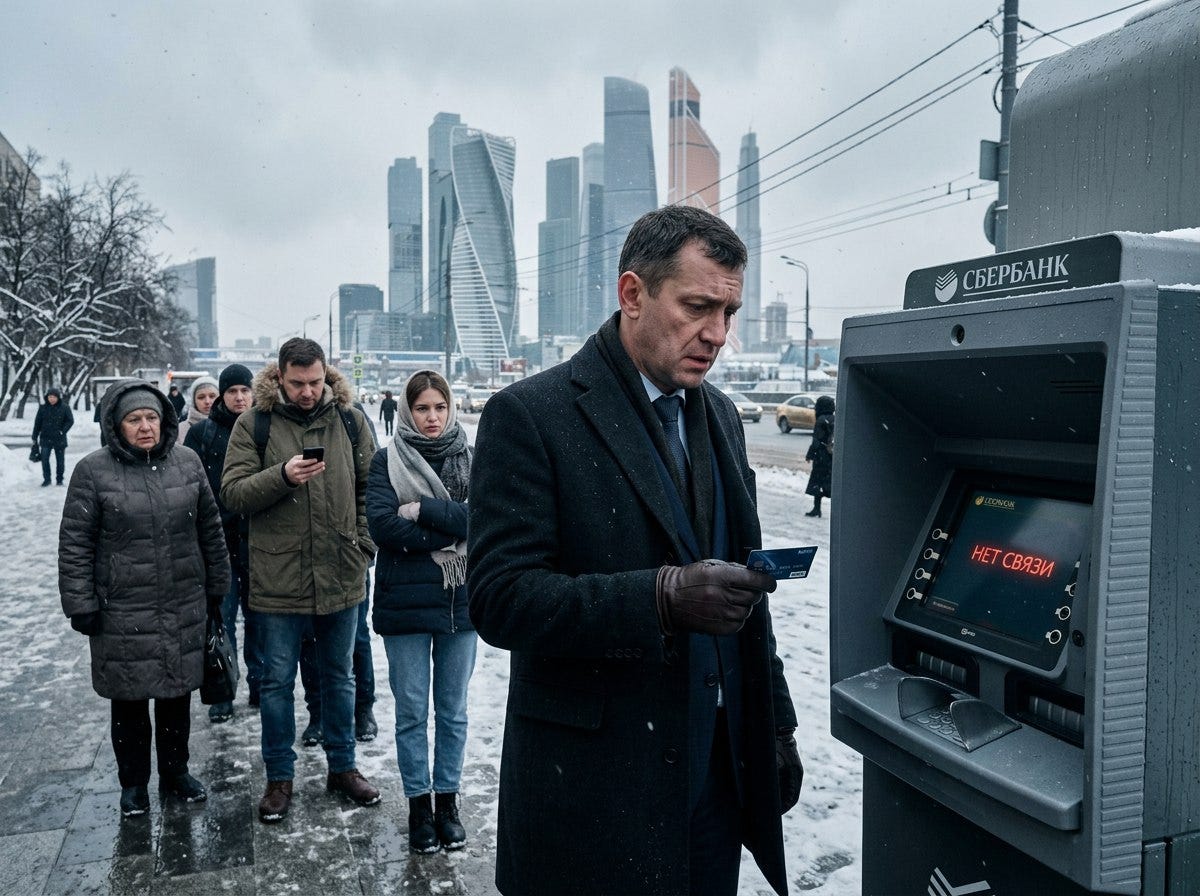
Russia is experiencing a genuine surge of political turbulence. Over the past week, Moscow has been gripped by disruptions caused by the near-total absence of mobile internet. It has become impossible to call a taxi or pay with a card; ATMs and payment terminals have stopped working. Businesses are losing millions of dollars, and residents are in a state of palpable shock.
Internet shutdowns are not new to Russia. In recent years, they have occurred with increasing frequency—but almost always in regional cities, not in the capital. What is new is that Muscovites themselves are now experiencing this reality. Many have noticed that the systematic disruptions to mobile internet began shortly after the outbreak of war in Iran. From this, some conclude that Russian security services may be preparing for—or rehearsing—a wartime scenario in which such restrictions would be imposed in Moscow, including measures aimed at protecting Vladimir Putin.
Other explanations are also circulating. One particularly persistent rumor holds that on April 1, Putin may decide to sever Russia from the global internet altogether, and possibly even announce a general mobilization. This speculation is especially striking given that, before the escalation in Iran, there had been serious talk in Moscow that Putin was closer than ever to ending the war and agreeing to meaningful negotiations with Ukraine and the United States. The war in Iran—and the dramatic surge in global oil prices—appears to have both alarmed him and, paradoxically, given him greater freedom of action.

GPS doesn’t work in Moscow anymore
Still, Russia’s internal turbulence is not just about internet disruptions. These outages are better understood as a symptom—one that amplifies a broader sense of anxiety. According to sources in Moscow, many within the Kremlin are now actively stoking discussions about potential political upheaval in the autumn. Parliamentary elections are scheduled for September, and they are widely expected to carry unusual risks this time.
It is in this context that some observers interpret the Kremlin’s apparent move toward a full blockade of Telegram, the most popular messaging platform in Russia. Telegram has become the primary source of news for many Russians, including reporting from independent media operating in exile. The authorities have long struggled to exert control over the platform and appear to believe that, with elections just months away, it is necessary to neutralize what remains one of the last major channels of relatively uncensored information.
The jittery, often inexplicable nature of the current moment is illustrated by the case of Ilya Remeslo, once a prominent pro-Kremlin blogger. A few years ago, he worked closely with the authorities and became one of the most visible figures among propagandists targeting Alexei Navalny. It was Remeslo who produced so-called “investigations” into Navalny’s activities—efforts that largely amounted to a mix of dubious compromising material, misinformation, and outright fabrication aimed at discrediting the opposition leader.

Ilya Remeslo
Then, suddenly, this week, something unusual happened. Remeslo published a post declaring that Putin was an illegitimate president, arguing that he had launched a senseless war with no chance of victory, while the public had been robbed and deceived. He then gave an interview to an independent YouTube channel—a popular exiled program broadcasting from Lithuania—in which he reiterated these claims, saying that he had undergone a personal awakening and become disillusioned with Putin, whom he had once admired.
The following day, reports emerged that Remeslo had been hospitalized and placed in a psychiatric facility. In effect, this has unexpectedly turned him into a prisoner of conscience.
Meanwhile, rumors continue to intensify. Many expect some kind of dramatic denouement in the coming weeks. April 1 is frequently cited as a possible turning point: according to one version, Putin may dismiss the government; according to another, he could shut down the internet and announce a new wave of mobilization; according to a third, he might instead recognize the severity of Russia’s economic crisis—and the limits of any relief from rising oil prices—and signal the start of genuine negotiations with the United States and Ukraine.
None of this may ultimately come to pass. And yet the atmosphere of tension—of heightened, almost febrile anticipation—has not been felt in Russia since the uprising led by Yevgeny Prigozhin. That, in itself, is a telling symptom.
Enjoyed article. There’s a noticeable change in what, “atmospherics,” with Telegram & other “internet turbulence.” ISW is reporting long-awaited new Russian “offensive” is underway in Ukraine. Be interesting to see if that does not go well in a big way for Russia.